
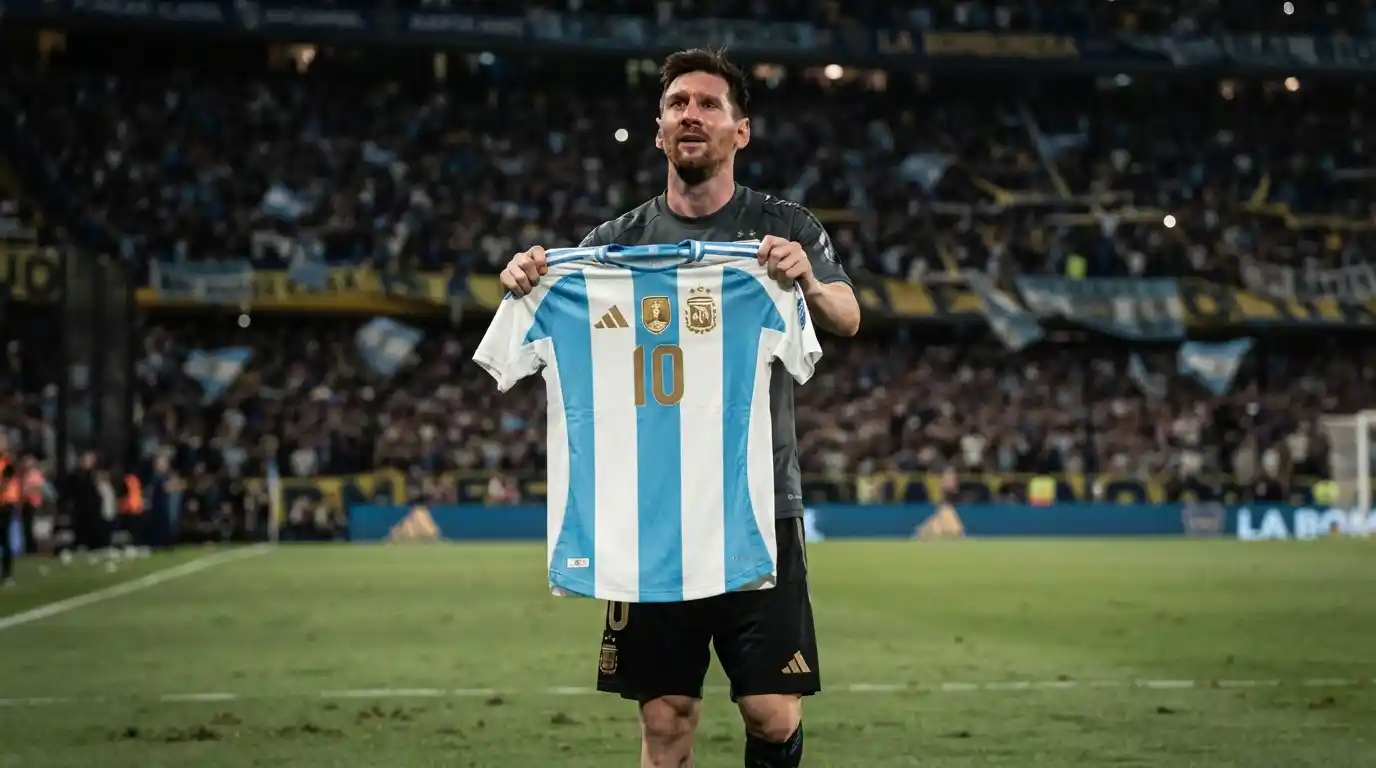
Lionel Messi is preparing to pull on the Argentina shirt one final time.
According to reports surrounding his international retirement, the 6 October friendly against Benin at the Monumental will serve as his official farewell. The No. 10 that defined an era is set to be retired in spirit with him — a symbolic end to the most dominant individual reign in modern football history.
The Argentine FA has long floated the idea of permanently withdrawing the number in Messi’s honour. While FIFA rules make a full official retirement complicated in competitive matches, the message is clear: after Messi, the famous 10 will never carry the same weight again.
The Numbers That Make This Farewell Feel Final
When Messi walks off the pitch for the last time in light blue and white, he leaves behind statistics that look more like system errors than human achievements.
91 goals in a single calendar year (2012)
At age 25 he scored 79 for Barcelona and 12 for Argentina. No player since — not Ronaldo, not Lewandowski, not Haaland — has come within touching distance. He averaged a goal roughly every 66 minutes. Seventy-eight of those strikes came from inside the box. It remains the most unbreakable individual scoring record in modern football.
8 Ballon d’Or awards
No one else has more than five. The gap is historic.
672 official goals for one club
Barcelona alone. A combination of longevity, loyalty and elite output that today’s transfer culture makes nearly impossible to replicate.
474 La Liga goals
The competition’s all-time record, and not by a small margin.
36 La Liga hat-tricks
Most elite strikers never reach double figures. Messi turned three-goal games into routine.
Record World Cup Man of the Match awards
Across five tournaments and two decades of the biggest stage, no player has collected more.
Why These Stats Make the No. 10 Untouchable
The 91-goal year required a perfect storm: peak physical condition, an all-time great Barcelona side in full tiki-taka flow, almost no injuries, and Messi operating as both creator and finisher at the same time. Modern football works against any repeat. Heavier rotation, tighter tactical marking of star players, and greater competitive balance have made single-player volume of that scale disappear.
Even Messi himself never got close again. That fact turns the record from “he might do it once more” into “a unique convergence that will not align again.”
The same logic applies to the rest of the list. Eight Ballons d’Or in an era of intensified competition. Nearly 700 goals for one club. A La Liga goal tally that sits in a different stratosphere. These are not just impressive numbers. They are structural outliers.
The End of an Era
Messi’s final appearance for Argentina closes a 21-year chapter that began as a teenage prospect and ended with a World Cup winner’s medal, two Copa América titles, and a body of work that redefined what individual greatness looks like.
The No. 10 shirt will never be the same. Whether Argentina can fully retire it under FIFA regulations or not, the number itself has already been retired in the only way that matters: no future player will ever fill it the way Messi did.
One last game. One final walk in the famous 10. And a set of statistics that will almost certainly never be repeated.
That is the real farewell.